enhanced procedures for continued cleanliness & hygiene

Travel is now, more than ever, a precious part of our lives. At Diethelm Travel, we’re dedicated to meeting the “new normal” of travel and ensuring all our guests, staff and suppliers stay safe with renewed optimism for travellers to visit our Asian destinations. We’ve implemented the following enhanced hygiene measures in response to the global pandemic to reassure guests as part of our new ‘Book with Confidence’ policy. This policy applies to all Diethelm Travel operations, including appointed third party supplier partners and personnel acting on behalf of the company, and marks the standards we’re enforcing across all Diethelm destinations with additional measures followed as necessary. For the safety and security of all guests, we always recommend travelling with a local guide to ensure expert guidance on not only the best travel experiences but also adhering to local and national practices. When travelling with us, your clients can rest assured that their safety is our number one priority. Enhanced Health & Hygiene Protocols Download Ongoing Support & Safety The measures listed above will apply to all bookings/enquiries made with Diethelm Travel until otherwise announced. With these added measures and regularly changing local restrictions, please note that additional time may be added between trips to ensure all hygiene practices are met. Larger travelling groups will also be assisted with further measures as required to ensure additional confidence while travelling. We are continuing to monitor trusted sources and governing authorities at a local, national, regional and global level to ensure that our practises meet international safety standards for all involved. As the best practices and impact of the global pandemic continue to unfold, we will adjust our standards accordingly. It is also always recommended for travellers to check recent updates from their country’s embassy as well as the destination’s they’re visiting to ensure all certification and medical advice is met before travelling. Please note: Additional measures and procedures placed upon customers by other travel partners such as hotels, airlines, seaplane transfers or any other third party suppliers working with Diethelm Travel will be communicated at time of booking and will be treated separately and supplementary to the above policy. Even more ways to book with confidence
9 must-try Malaysian dishes
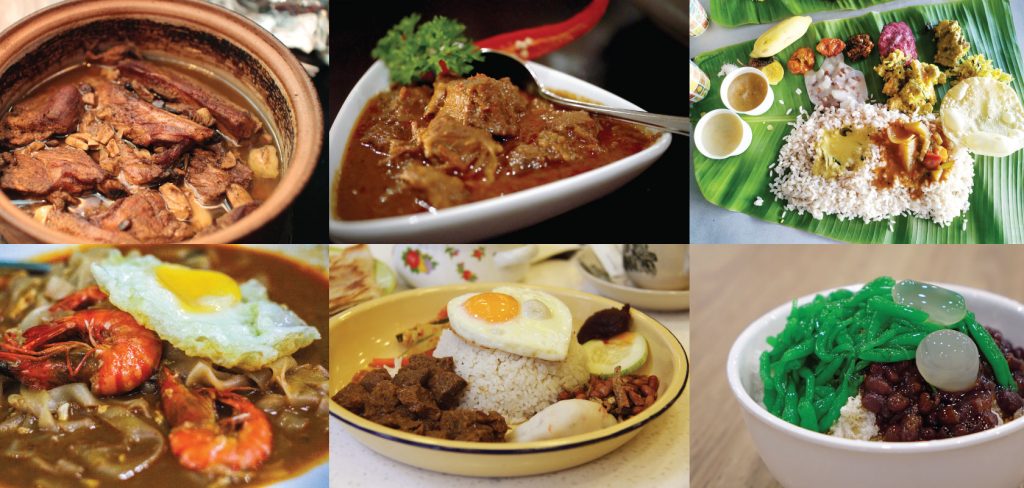
Combining Chinese, Indian, Indonesian and Malay culinary influences, foodies in Malaysia can easily makan (Malay for “eat”) their way through the country. With the breadth and depth of options, however, it can be overwhelming deciding what to try first. Don’t miss these incredible dishes…or the opportunity to experience them with a local! Nasi Lemak A consistently popular pick, nasi lemak consists of white rice soaked in coconut cream then steamed and served in a banana leaf with a hard-boiled egg, sliced cucumber, dried anchovies, roasted peanuts and plenty of sambal. Some variations come with pickled vegetables, beef rendang or even more accompaniments. Assam Laksa & Curry Laksa Malaysia’s version of noodle soup, laksa comes in a variety of forms but two of the most popular are assam laksa, spicy-sour fish broth flavoured with tamarind, and curry laksa with added spice and creamy coconut milk. Bak Kut Teh Literally meaning “meat bone tea,” bak kut teh is a hearty, savoury blend of slowly simmered pork ribs swimming in a mélange of herbs and spices, such as star anise, cinnamon, cloves, fennel seeds and garlic. Banana Leaf Rice Coming from southern India, banana leaf rice consists of white rice and a selection of curries, vegetables, pickles and crispy pappadom served on a banana leaf and eaten by hand. Beef Redang Perhaps Malaysia’s most well-known dish, beef redang boasts succulent cuts of beef slowly cooked in in coconut milk and tonnes of spice for incredibly complex flavour in every bite. Rojak The appropriately named rojak, meaning “mixture” in Malay, is a type of local salad often featuring different fruits, dough fritters and other ingredients tied together with a dark, sticky dressing of fermented prawn paste, sugar, lime and chilli paste. Best enjoyed fresh, the salad offers the perfect blend of sweet, sour and spicy! Char Kuey Teow Another dish with strong Chinese roots, char kuey teow is made with flat rice noodles stir-fried with soy sauce, chillies, cockles, bean sprouts and Chinese chives over high heat. Apom balik Of course, you can’t forget dessert! Similar to a large, folded-over pancake, apom balik is a popular street-side sweet with a slightly crisp shell and soft, hot inside stuffed with sweet fillings, like sugar, crushed peanuts and corn. Cendol Common throughout Southeast Asia, especially when it’s hot out, cendol consists of shaved ice topped with green-hued rice flour jelly, coconut milk and palm sugar syrup.
an insider’s look at exploring Malaysia
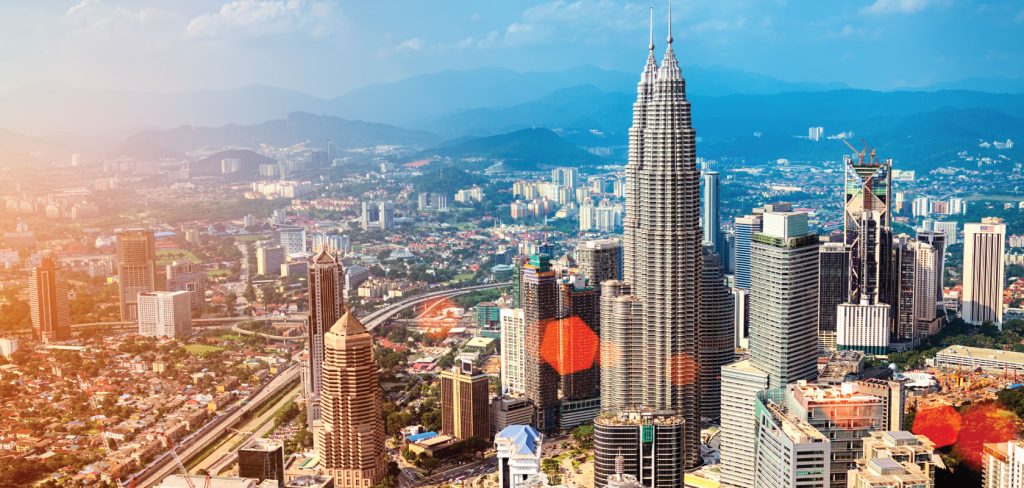
With a knack for tracking down off-the-beaten-path destinations, Renee Osman, Head Of Sales & Marketing for Diethelm Travel Malaysia, has spent nearly a decade helping travellers explore Malaysia and leave with lasting memories. Here’s what she had to share for an insider’s look at this enigmatic country. What is your favourite tourist hotspot? I would have to say the Petronas Twin Towers thanks to their sheer domination of Kuala Lumpur’s skyline and prominent recognition in the heart of our lovely city…it’s an icon of Malaysia! This is a classic example of my favourite hotspot – the building is surrounded by KLCC Park, a green haven that boasts Lake Symphony, jogging tracks, walking paths, waterfalls, fountains and reflecting pools. It also has cool restaurants located at the foot of the building in Suria, making it a place where I like to chill in the evening after office hours too! What is a secret, under-the-radar destination you always recommend? Located in the heart of Sabah, Deramakot Forest Reserve is indeed a hidden gem and my absolute favourite “under-the-radar” destination. Rich in wildlife with 75% of Sabah’s mammal species found within its 55,507 hectares of mixed dipterocarp forest, Deramakot is one of Sabah’s best wildlife watching destinations and is only accessible by four-wheel-drive vehicles. How/where would you spend a long weekend? I live in Kuala Lumpur and among the city’s perks is our highway connectivity. For a long weekend, my family and I enjoying heading out on a 2.5-hour drive to the old town of Ipoh. Here you can discover a wealth of interesting history, gorgeous street murals, amazing local food and engaging outdoor activities such as caving, water rafting and abseiling. There’s so much to do in this little town…we love going back again and again. What is one Malaysian dish travellers must try? If I could only choose one, I’d pick the dish that is loved by everyone in this country: nasi lemak. It’s basically just rice cooked in coconut milk but it’s the side dishes that really matter. Depending on where you are in Malaysia, nasi lemak comes with a variety of flavourful accompaniments such as hard-boiled eggs, peanuts, vegetables, lamb/chicken/or beef curry, seafood and sambal (chilli-based sauce). What’s a misunderstanding or misconception you think others have about Malaysia? Malaysia is officially a Muslim country with approximately 60% of the population being Muslim and it holds a set of beliefs regarding social customs that may seem conservative to some travellers. While that’s true, Malaysians are also an incredibly diverse, multicultural bunch and are respectful towards each other’s different beliefs and cultures – more than 140 languages are spoken in the country! There are also plenty of destinations in Malaysia with clubs, bars and restaurants serving alcohol to cater to international guests. What is a stereotype about your country that is absolutely true? We love food. A mix of different cultures and flavours, Malaysian dishes are often the subject of intense debate for many Malaysians on what is the best. Food plays such an important role throughout the country that it’s common for us to greet one another not by asking “How are you?” but “Dah makan?” meaning “Have you eaten?”. And, yes, we need to eat rice every day – a day isn’t complete without it! What is one thing you wish all visitors knew before travelling to the country? The people in Malaysia are warm and friendly – we are willing to give suggestions, lend a helping hand or simply welcome you with a smile. Most Malaysians speak English, but you’ll be able to feel the warm welcome even when there is a language barrier. What restaurant do you always take friends visiting from out of town to? My go-to has to be SPG by Bijan in Kuala Lumpur. Located at Jalan Ceylon, this restaurant offers a new wave of modern Malay cuisine in a lovely tropical terrace lounge within a secret bungalow. What Diethelm Travel tour have you enjoyed the most? My family and I loved the overnight trip to Lemanak River in Sarawak – Sarawakian hospitality is hands-down the best! A visit to Sarawak is not complete without visiting an authentic Iban longhouse. Traditional longhouses are no longer easy to find due to widespread developments, but this tour offers a real longhouse experience and chance to connect with different tribes in Sarawak, complete with beginning the journey travelling in a shallow draught canoe. (Also, the longhouse we take guests to has been supported by Diethelm Travel Malaysia for over a decade to help maintain not only the original structure but traditional customs in the surrounding region.) Where is one place in the country you would like to visit but have never been to? I’ve never had a chance to visit Tawau. The town is a gateway to many unique places, including Tawau Hills National Park (where you can spot pygmy elephants on a private plantation) and Sipadan Island, which is one of the best dive spots in the world. What is one activity or experience you’ve never done in the country but would like to? I would love to experience Diethelm Travel’s 2-Day Marine Biology Awareness course in Kota Kinabalu. The programme offers a chance to learn more about the local marine ecology, conservation projects and how tropical ecosystems are severely threatened by human activities. Travelling for me is not just about visiting beautiful places but also a journey of learning.
get to know the incredible Orangutan and where to see them
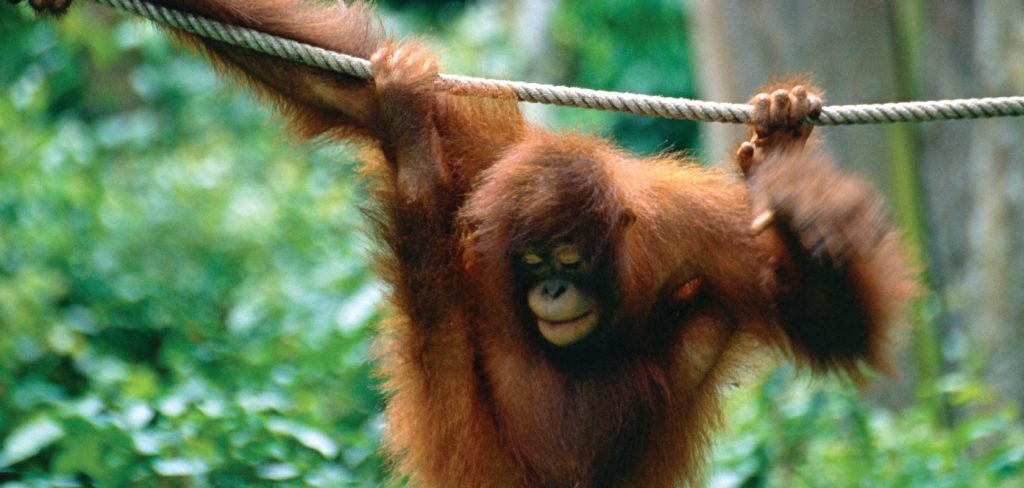
Native to Malaysia and Indonesia, orangutans are incredible creatures. If they seem similar to humans, that’s because they are! In fact, the term “orangutan” in Malay and Bahasa Indonesia translates to “person of the forest” with orang meaning “person” and “hutan” meaning forest. It’s not only their name that connects them to humans, however. The great apes boast 96.4% of the same genes we humans have, making them one of the closest animal relatives to humans. They’re extremely intelligent creatures that reason and think, and even express emotions like joy, fear, anger and surprise. Infant orangutans cry when they’re hungry, whimper when they’re hurt and smile at their mothers. Though large, orangutans are usually quite gentle, living their lives quietly up in the trees hidden away from predators and only descending to the forest floor when they must. Female orangutans and their young may gather in one area if there is an abundant food source but they do not live together in social groups and typically claim their own territories covering several kilometres. Why are orangutans going extinct? All three orangutan species are classified as Critically Endangered according to the International Union for the Conservation of Nature and Natural Resources (IUCN) meaning they are close to becoming extinct in the wild. The number one threat to orangutans is deforestation – often due to palm oil operations and other agricultural endeavours. As the orangutans’ natural habitat disappears, their food sources become more limited, which makes it harder to find food and forces them into areas with humans where they’re more likely to be caught or killed. Unfortunately, young orangutans are still captured to sell as pets. When they’re captured, the mother will often be killed, further reducing the species’ chance to reproduce. That said, there are many organisations and efforts working to conserve these precious primates and their natural habitats. Where can you still see orangutans in the wild? Orangutans used to roam from southern China to Java. Today they’re only found on two islands – Sumatra in Indonesia and Borneo, which is shared by the Malaysian states of Sabah and Sarawak, along with Indonesian Kalimantan and Brunei. These areas, especially Borneo, are home to a number of orangutan sanctuaries, wildlife reserves and conservation centres that offer ethical ways to learn more about these incredible creatures while also helping support their conservation or rehabilitation. (These islands are home to many other threatened species as well, such as the Sumatran tiger, clouded leopard and Asian elephant.) In Malaysian Borneo, these parks offer the best opportunities to catch a glimpse of the man of the forest: Kinabatangan Wildlife Sanctuary, Sabah Danum Valley, Sabah Deramakot Forest Reserve, Sabah Tabin Wildlife Reserve, Sabah Batang Ai National Park, Sarawak Find out more about these parks and how to visit them HERE!
the story of Thai silk…and how to wear it
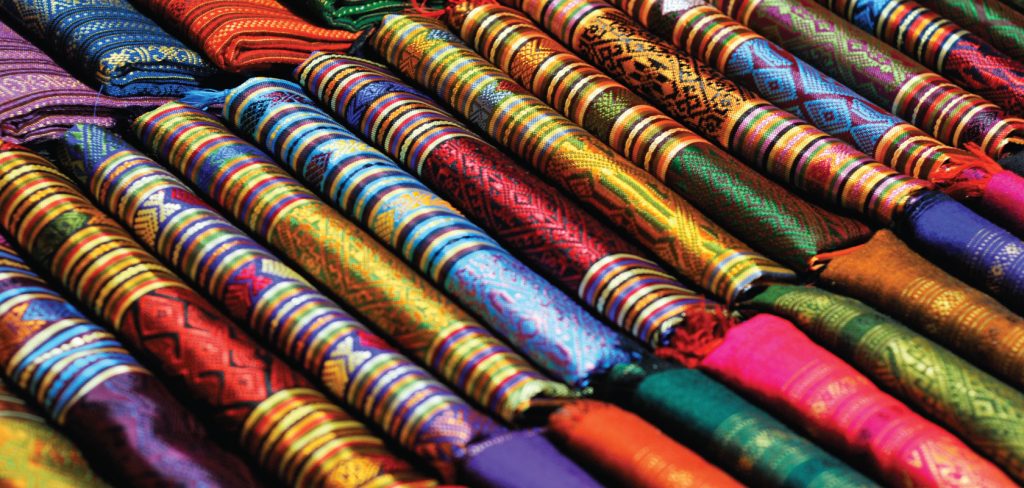
Though Thai silk is now known around the world, its history has been a complicated one. The silk that we know today was actually popularised in the 1950s and 60s by an enigmatic American architect, Jim Thompson, who recognised that Thai silk could have great appeal in international markets. As the demand for Thai silk took over, the industry within Thailand started booming once again. In 2003, the Queen Sirikit Museum of Textiles opened in Bangkok to further help support the preservation of silk making, from farming silkworms and dyeing silk thread to weaving fabric and sewing garments. The museum, which can be accessed with a Grand Palace admission ticket, also supports public awareness of Thai identity and culture, and the beauty of Thai traditional textiles. Types of Thai Silk Thai silk has many unique characteristics, including a tightly-woven fabric, fine grain and lustrous colours that do not fade after washing. There are also many different traditional styles or designs that mark true Thai silk, including: Mudmee – Known for its complex geometric patterns and often using two colours, mudmee is made using a weaving method called Silk threads are dyed prior to weaving so that the vertical warp provides the fabric’s colour while the horizontal weft provides the pattern. Plain Weave – Plain weave silk uses uniform threads to produce an even, consistent and smooth finish. Often two colours are woven together to create a two-toned shine. Dupion – For dupion, threads of varying thickness with knots or lumps are used for a more organic, textured finish. Brocade – Brocade patterns are crafted using extra silk thread during the weaving process to produce an embossed or embroidered texture. This is the most complicated type of Thai silk to produce. Who wears Thai silk Silk can be worn in many ways, such as tailored into a blouse or skirt, or as a scarf or sarong. Although in modern days it is not common to see many Thais purchasing silk fabric to then be tailored, it’s still popular for some generations. Sarongs are one of the most popular ways to buy and wear silk, so you’ll often see beautiful woven sarongs hanging in shops or at the market for sale. Some of the silk sarong prices can go from THB 5,000 up to THB 50,000 (or more!) depending on the size, quality, weaving technique and pattern. (If you are looking to buy silk and the price is cheaper, you can assume that it may be synthetic!) Thai silk can be worn by anyone for any occasion but, because of its costs, is often saved for special occasions such as engagements, wedding ceremonies or other important events. Where to buy Thai silk You can find Thai silk throughout Thailand but be wary of the quality. If silk is priced at a number that seems too good to be true, that is probably because it is. In Bangkok, some trustworthy stores include the Jim Thompson House Museum, the Jim Thompson Factory Outlet and Queen Thai Silk. You can also purchase Thai silk in the shopping malls throughout Bangkok. Chatuchak Weekend Market is home to cheap Thai silk, if you don’t care whether the material is synthetic or not. If you travel through the north and northeast of Thailand, you will also find many family-owned operations still farming silk worms and weaving their own silk so you can be sure to get authentic silk fabric to take home! How to wear Thai silk Have a piece of silk and wondering how to wear it? The below video will show you three simple ways to wear a silk sarong simply and beautifully. You can also order Thai silk online and we recommend checking out the shop in the above video that was kind enough to share how to wear sarong properly! See more here.
4 of Thailand’s most unique festivals
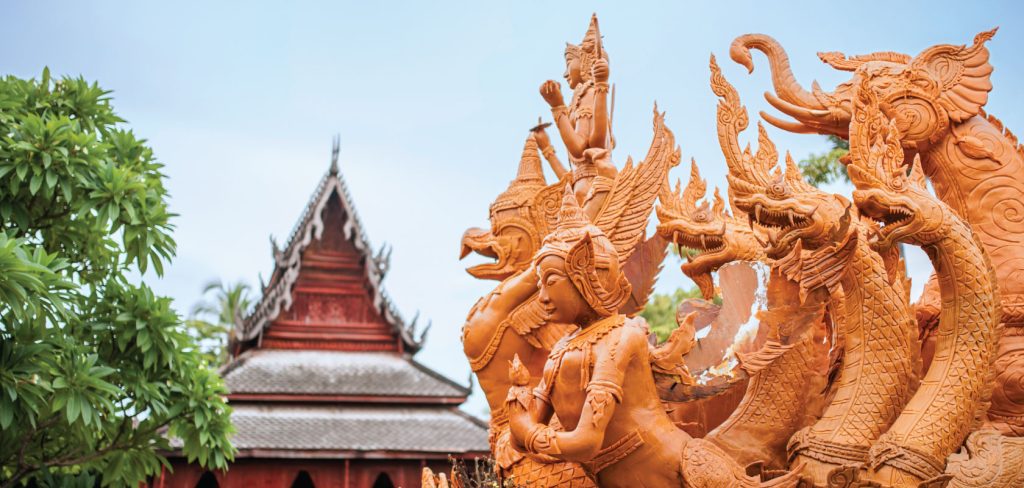
Spend any time in Thailand and you’ll soon realise there always seems to be something to celebrate. From nation-wide holidays, such as the famous Songkran and Loi Krathong, to lesser-known local festivals, the country has kept many of its traditional celebrations alive and invites visitors to experience them with open arms. Here are just four of Thailand’s unique festivities found in different regions across the country. [showimage url1=”https://www.diethelmtravel.com/wp-content/uploads/2020/05/Website_Lopburi-Monkey-Banquet-and-Festival-02.jpg”] CENTRAL Lopburi Monkey Banquet Location: Lopburi town Dates: Usually the last Sunday in November Located 150 kilometres north of Bangkok in Lopburi, this isn’t your typical Thai food festival! Lopburi is famous for the countless monkeys that reside in the centre of town and one of the most popular activities for tourists when visiting Lopburi is feeding the creatures. Come November, the town lays out an impressive public banquet of fruits, vegetables and other treats for the monkeys to feast on. [showimage url1=”https://www.diethelmtravel.com/wp-content/uploads/2020/05/Long-Boat-Racing-Thailand-03.jpg”] NORTH Nan Traditional Boat Racing Festival Location: Nan town Dates: September/October Long-boat races have taken place for centuries (even being traced back to the Ayutthaya period) to commemorate the end of the Buddhist Lent. Held during the 10th or 11th lunar months (around September/October) when the water levels are at their peak, decorated long boats, or dragon boats, take to the waters to race while spectators gather on the riverbanks to cheer on the teams, eat, drink and be merry. In the northern Nan province, the main town (also called Nan) is one of the best places in the country to join in the activities as the Nan River snakes right through town. [showimage url1=”https://www.diethelmtravel.com/wp-content/uploads/2020/05/Candle-Festival.jpg”] NORTHEAST Candle Festival Location: Ubon Ratchathani Dates: July Celebrated during two of Theravada Buddhism’s most significant holidays – Asanha Puja commemorating the Buddha’s first sermon and Khao Pansa marking the start of Buddhist Lent – Ubon Rachathani’s Candle Festival is a picturesque affair. As the largest local festival of the year, locals enjoy parades featuring elaborate floats carved out of candle wax depicting scenes from the Buddha’s life and Thai Buddhist art motifs, as well as other cultural performances, Muay Thai boxing matches and plenty of street food. [showimage url1=”https://www.diethelmtravel.com/wp-content/uploads/2020/05/Phuket.jpg”] SOUTH Phuket Vegetarian Festival Location: Phuket Town Dates: One week during the 9th lunar month (usually in October) Though some version of the annual vegetarian festival is recognised throughout the country, with people choosing to eat meat-free dishes for one week, the most famous festivities happen on the island of Phuket. Based on a Chinese tale that teaches abstaining from meat will help lead to longevity, the festival is marked by Phuket’s rather extreme version of celebrating. Along with not eating meat, devout believers and conduits to the gods will pierce their bodies in gruesome ways or walk over fire to honour the gods and prove that they’re protected.
10 things you didn’t know about Thailand
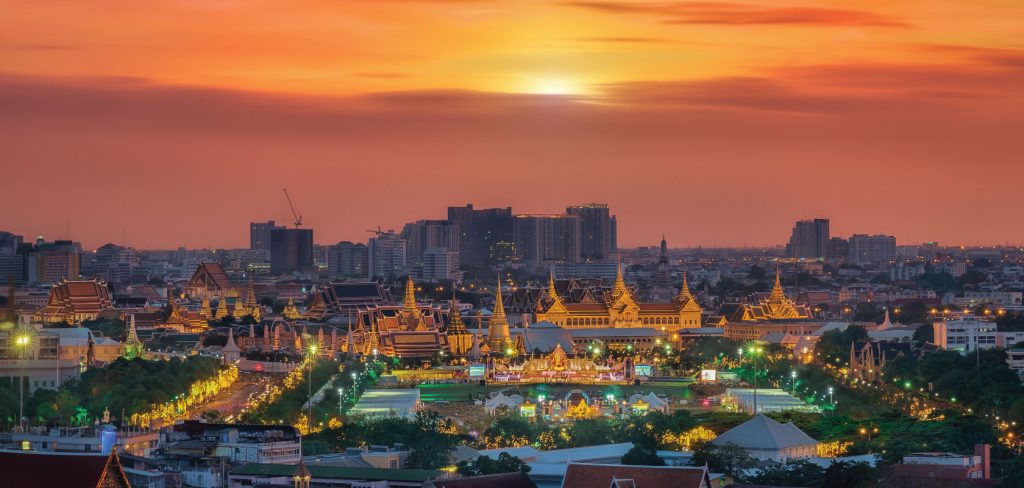
Whether you’ve visited Thailand for years or have never set foot in the Land of Smiles, we bet that several of these fun Thailand facts will come as a surprise! [showimage url1=”https://www.diethelmtravel.com/wp-content/uploads/2020/05/Bangkok-Thailand.jpg”] Bangkok boasts the longest city name in the world Did you know that Thais don’t call Bangkok Bangkok? Instead, they refer to the capital as Krung Thep. This is actually a shortened version of the city’s full ceremonial name, which is: Krungthepmahanakhon Amonrattanakosin Mahinthara Yutthaya Mahadilok Phop Noppharat Ratchathani Burirom Udom Ratchaniwet Mahasathan Amonphiman Awatansathit Sakkathattiya Witsanukamprasit. The name roughly translates to “City of Angels, Great City of Immortals, Magnificent City of the 9 Gems, Seat of the King, City of Royal Palaces, Home of Gods Incarnate, Erected by Visvakarman at Indra’s Behest.” [showimage url1=”https://www.diethelmtravel.com/wp-content/uploads/2020/05/King-Bhumibol-Adulyadej.jpg”] Thailand had the world’s longest-reigning monarch The revered King Bhumibol Adulyadej the Great reigned over Thailand for 70 years and 126 days making him the world’s longest-reigning head of state and the longest-reigning monarch in Thai history. The National Anthem is played publicly twice a day Every day at 8:00 hours and 18:00 hours the Thai National Anthem is broadcast across all television and radio stations as well as public places like schools, train stations, shopping malls and markets. Everyone in the vicinity will stop moving to listen respectfully then slightly bow as the song ends before continuing to go about their business. The King’s Anthem is played before films If you go to the cinema in Thailand, get ready to stand with the rest of the audience before the film as The King’s Anthem is played to an accompanying video montage. Not only is it expected to stand respectfully, but not doing so is illegal! [showimage url1=”https://www.diethelmtravel.com/wp-content/uploads/2020/05/4244978_orig02.jpg”] Thailand is the only Southeast Asian country that was never colonised by a European power In the 19th century, while France was taking over countries like Cambodia, Laos and Vietnam and Britain colonised Burma, Thailand managed to maintain its independence thanks to its strategic location and intelligent King Rama V who ceded small portions of land to the European powers to further ensure peace. The fact is still a source of great pride for Thais to this day. [showimage url1=”https://www.diethelmtravel.com/wp-content/uploads/2020/05/isolated-vacation-asian-reflection-money.jpg”] Thai coins feature Bangkok temples When in Bangkok, try to match your Thai coins to their real-life counterparts. Each coin is stamped with the picture of a significant temple, or wat, all of which are located in Bangkok. 1 baht: Wat Phra Kaew (also known as the Temple of the Emerald Buddha inside The Grand Palace) 2 baht: Wat Saket (also known as the Golden Mount or Temple on the Mount) 5 baht: Wat Benjamabophit (The Marble Temple) 10 baht: Wat Arun (Temple of Dawn) [showimage url1=”https://www.diethelmtravel.com/wp-content/uploads/2020/05/Chao_Phraya_River_from_CAT_building_8134954465-02.jpg”] Bangkok was once known as the “Venice of the East” The swampy lands around the Chao Phraya River in central Thailand made it so the country’s capital was built on stilts and used a complex system of canals as transportation waterways earning Bangkok the nickname of “Venice of the East.” Today, most of the canals have been filled in and are now the city’s streets but you can still find plenty of canals, particularly in older parts of the city or across the river in Thonburi, that are traversed by boats ferrying people around the region. [showimage url1=”https://www.diethelmtravel.com/wp-content/uploads/2020/05/Chinatown-is-in-Bangkok02.jpg”] The world’s largest Chinatown is in Bangkok Known as Yaowarat, Bangkok’s sprawling Chinatown is home to over a million ethnic Chinese and one of the city’s most colourful districts to explore. During the day, shops and stalls sell all products imaginable while at night food stalls take over the streets. [showimage url1=”https://www.diethelmtravel.com/wp-content/uploads/2020/05/8502409652_07ed055714_o2.jpg”] Red Bull originated in Thailand Though popular around the world, the caffeine-packed Red Bull energy drink, known as Krating Daeng in Thai, was created in 1976 in Thailand and has been a popular brand within the country ever since. The original, syrup-like drink is quite different from the carbonated version the rest of the world knows and now you can find both to try while in the Land of Smiles. The Thai language includes 76 characters You read that right – the Thai language is made up of 44 consonants and 32 vowels totalling 76 characters to memorise…not to mention five different tones!
tour the story of the Ramakien at Bangkok’s Grand Palace
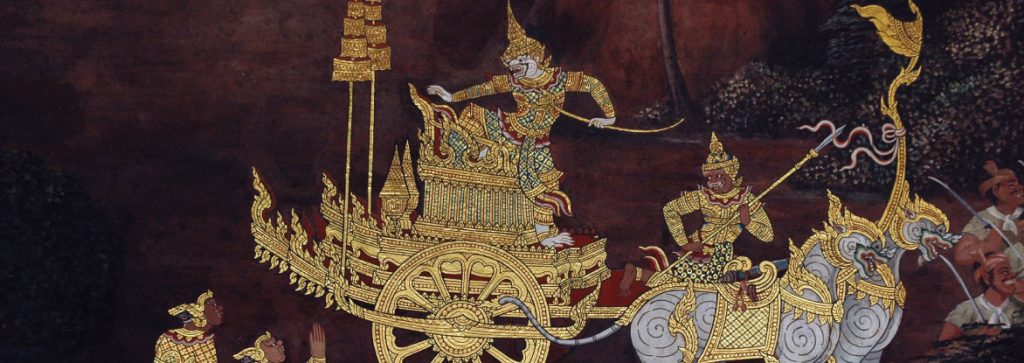
The outer walls surrounding Wat Phra Kaew (the Temple of the Emerald Buddha) at Bangkok’s Grand Palace aren’t simply for decoration. A total of 178 wall panels are painted with murals depicting scenes from the Ramakien, the Thai version of the Indian epic, Ramayana. Stretching out over long corridors with bright red ceilings, the paintings create a continuous narrative without any clear break between the scenes. The Ramakien is a fascinating tale about good triumphing over evil following the battle between King Rama and Tosakanth, the King of the Demons. Tosakanth falls in love with King Rama’s queen, named Sida. He kidnaps her and takes her to his palace in Krung Longka in hopes that she will fall in love with him. Naturally, a magnificent battles ensues as King Rama tries to save his queen. Although Tosakanth has a powerful demon army and evil magic spells at his disposal, King Rama has Hanuman (the god-king of the apes) who leads an army of both monkey and human warriors, helping King Rama defeat Tosakanth and win back Sida. If you’re unfamiliar with the story however, the murals can be a bit overwhelming and bring up questions, which is why it’s always a smart idea to visit the Grand Palace with a guide. We asked one of our most popular Thai guides, Khun Anu, what some of his secrets that he shares with guests are when visiting the Grand Palace. Here’s what he had to say… “When I take guests to tour the Grand Palace, one of the main attractions we spend time at is the world’s longest mural at the gallery near Wat Phra Kaew. While the story is a classic, visitors can tend to start getting bored because there is so much to look at…so I have a little technique to keep things interesting! Each corner of the 178 scenes holds a small, funny or cultural secret left by the original painter and restorers that adds a dose of humour to the story. These unexpected images are hidden within the main storyline. While the focus of the painting is usually at eye-level, artists have added scenes of daily life and even silly surprises either below or above the action. Scroll down to see some of the incredible scenes…as well as some of my favourite surprises!” In the murals, King Rama’s palace is a drawn using the Grand Palace’s structure and design. Here Tosakanth is trying to make Queen Sida fall in love with him after he has kidnapped her and taken her to his palace. Here we have a soldier who is leaving to go to battle…but not before running back to grab a traditional Thai snack made by his wife at home! Here a demon warrior walked past a man selling sweets and just had to stop to buy one before heading to battle. Here Hanuman is leading the monkey army to attack Krung Longka but the city is surrounded by a river. Since the monkeys cannot swim, Hanuman casts a spell upon himself to become larger and act as a bridge for the monkey army to cross. Thai people paying respects to a spirit house and asking the house’s inhabitants to protect their son who is heading to war. A small boy sticks out his tongue at a palace security guard. Here a demon warrior was taking a nap during his shift
The story of ta phrom’s strange stegosaurus
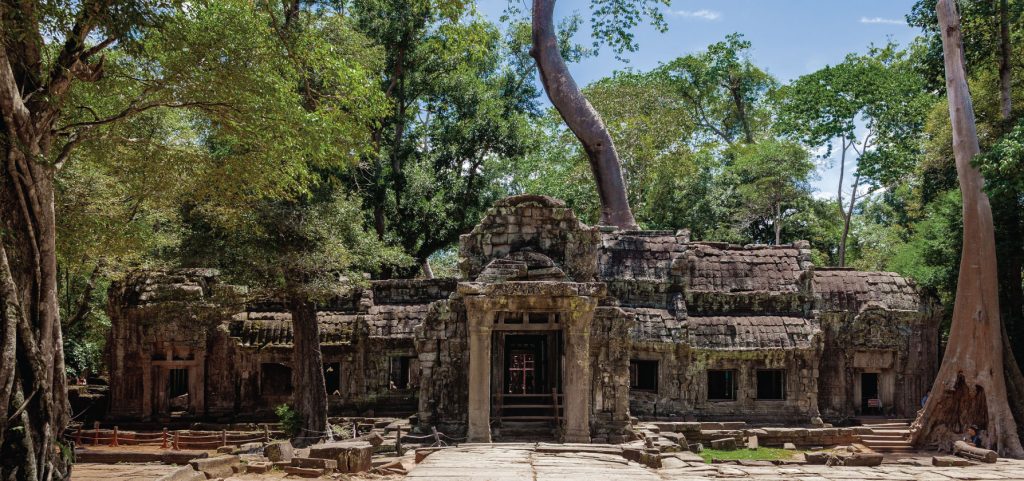
Covered in intricate carvings and bas reliefs, the Angkor temples are known for their incredible craftsmanship and impressive designs. Apsaras (heavenly beings) adorn the walls of Angkor Wat while 216 giant faces grace the towers of Prasat Bayon. Though Ta Prohm temple is recognised for its jungle-like setting with silk-cotton and strangler fig trees growing over the crumbling walls, it also boasts some well-preserved carvings, including one very unlikely design…a stegosaurus! Ta Phrom may be best-known for its epic tree roots and role in the 2001 Tomb Raider film, but the fascinating temple’s odd dinosaur carving is also an enigmatic draw for visitors in the know. Located in a corner of a courtyard, left of the central exit, a small stegosaurus is carved into the stone. Since the temple was built by King Jayaraman VII in the late 1100s, the perplexing carving brings up several questions and theories – how did the ancient Khmer kingdom know what a stegosaurus was? While some believe the Khmer may have unearthed dinosaur fossils, others think that the carving must have been made recently as a joke or hoax. Still, others believe that perhaps this shows dinosaurs lived in Southeast Asia much, much later than previously believed. Then again, the carving may be a cow or water buffalo in front of palm fronds which, to our modern eye, simply looks like a stegosaurus. Though we may never know the truth, it’s still fun to be let in on Ta Phrom’s secret and spot the mysterious stegosaurus on a visit to the temple! Let’s see if you can find it: https://www.google.com/maps/about/behind-the-scenes/streetview/treks/angkor/
10 things you didn’t know about cambodia
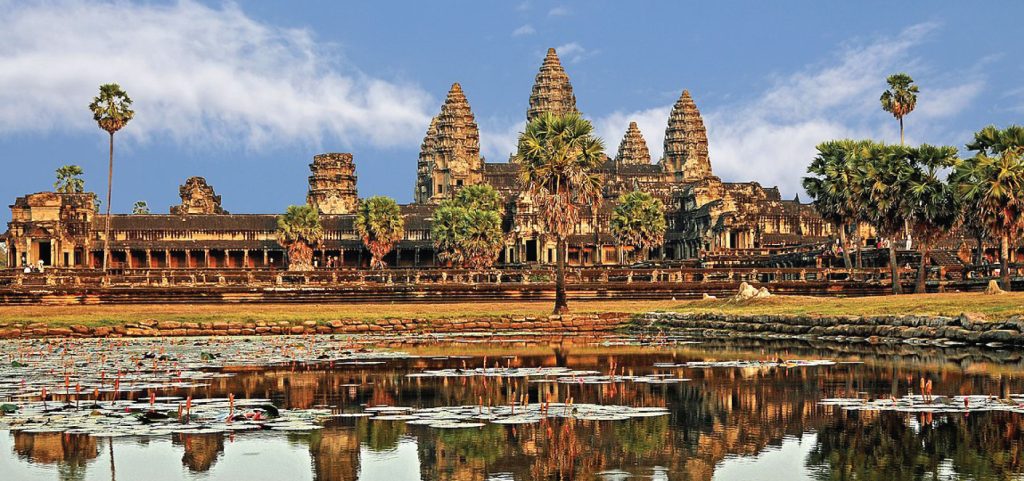
While Cambodia’s greatest claim to fame, the ancient Khmer civilisation and remaining Angkor complex is fascinating, the country has even more fun facts to share. [showimage url1=”https://www.diethelmtravel.com/wp-content/uploads/2020/04/Web_shutterstock_1051439405.jpg”] 1. Angkor Wat is the largest religious structure on Earth The massive Angkor Wat complex holds the honour of being the world’s largest religious structure covering 1,626,000 square metres, or about 400 acres. Angkor Wat is so large that it’s more than double the size of the world’s second-largest religious complex, Sri Ranganathasvamy, a Hindu temple in India. [showimage url1=”https://www.diethelmtravel.com/wp-content/uploads/2020/04/Web_cambodia-3639224_1280.jpg”] 2. Cambodia’s flag is the only one in the world with a building on it While Cambodia’s flag boasts popular colours of red, white and blue, it’s the only flag in the world to have a building on it – an outline of the illustrious Angkor Wat. [showimage url1=”https://www.diethelmtravel.com/wp-content/uploads/2020/04/Web_shutterstock_1022606863.jpg”] 3. Cambodia goes by many names Known as the Kingdom of Cambodia in 1953, the country went through five name changes – such as The Khmer Republic and The People’s Republic of Kampuchea – as new reigns came into power only to return to the Kingdom of Cambodia. [showimage url1=”https://www.diethelmtravel.com/wp-content/uploads/2020/04/Web_shutterstock_614310731.jpg”] 4. There is no McDonald’s in the country Cambodia is one of the few countries in the world where McDonald’s hasn’t laid down roots. Oddly, the country does have a Burger King. [showimage url1=”https://www.diethelmtravel.com/wp-content/uploads/2020/04/Web_shutterstock_448355728.jpg”] 5. Geckos can predict marriage Many Cambodian locals believe that counting the chirps of a gecko will predict whether one will marry or not. It’s also considered good luck if a tokay gecko is in the same room and calls out seven or more times. [showimage url1=”https://www.diethelmtravel.com/wp-content/uploads/2020/04/Web_shutterstock_363187631.jpg”] 6. Cambodian weddings go on for three days Though the length of wedding celebrations depends on the families’ financial circumstances, the typical Cambodian wedding lasts for three days of festivities. [showimage url1=”https://www.diethelmtravel.com/wp-content/uploads/2020/04/Web_North-Khleang.-Angkor-Thom.-Cambodia_shutterstock_1176582139.jpg”] 7. Funerals can cost around USD 9,000 in Cambodia Though the average monthly income in Cambodia is just over USD 100, Cambodian funerals can last up to 49 days with the average expenses coming out to USD 9,000. Proper funerals are incredibly important in this traditional country and families often must pool together savings to cover the cost of the funeral. [showimage url1=”https://www.diethelmtravel.com/wp-content/uploads/2020/04/Web_Ancient-Buddha-statue-in-Bayon-temple-Angkor-Siem-Reap-Cambodia_shutterstock_740515462.jpg”] 8. Millions of active landmines are still scattered across the country In the early 1990s, Cambodia was one of the most heavily mined countries in the world with an estimated 8 – 10 million landmines. It’s believed that there are still several million active mines buried throughout the country’s rural countryside that organisations are trying to detect and dismantle the explosives. [showimage url1=”https://www.diethelmtravel.com/wp-content/uploads/2020/04/Web_shutterstock_1106886017.jpg”] 9. The country is home to rare animal species Once thought to be extinct in Cambodia, the Asian giant softshell turtle, also known as Cantor’s giant softshell turtle or the “frog-faced” turtle, is making a comeback in parts of the Mekong River. Also in the Mekong, you can find critically endangered Irrawaddy dolphins, which look like small beluga whales. [showimage url1=”https://www.diethelmtravel.com/wp-content/uploads/2020/04/Web_The-village-on-the-water.-Tonle-sap-lake.-Cambodia_shutterstock_105735020.jpg”] 10. The Tonle Sap is the largest freshwater lake in Southeast Asia Covering around 10,000 square kilometres during the rainy season, the unique freshwater lake shrinks to just 3,000 square kilometres in the dry season.